Over the past year I have travelled up and down the UK, meeting and interviewing fifty-two remarkable and generous people. They all took an Interrail trip at some point between 1972 and 1997, and I wanted to find out more about their youthful travel adventures. It was a privilege to hear and record their stories.
Since completing the main interview stage of my research project, I have reflected on what I have learnt about conducting oral history interviews. Although I had carried out many research interviews over the years in academic and professional settings, I was a novice oral historian when I began meeting with Interrailers in May 2023. Conducting more than fifty interviews in a concentrated period developed my skills considerably and I have become a much sharper listener.
Recruiting
A challenge for many researchers is finding willing participants. I set a target of conducting at least forty interviews which I anticipated would be a stretching but achievable number. My preliminary enquiries had suggested that Interrailers were keen to talk about their travel experiences. Nonetheless, when approaching potential recruits, I tried to emphasise what might motivate them to say ‘yes’ to an interview rather than setting out what I wanted to achieve. I discovered that it was persuasive to offer the rare opportunity of an attentive audience for an hour or two.
I believe that each point of contact, whether in writing or verbally, is an opportunity to engage people with my research project. I found a third of my participants via social media, mainly through the Facebook group ‘Interrailing for the Older Crowd’ and the channels of my partner organisation, the Museum of Youth Culture. But equally important sources were introductions from participants, friends, family and professional contacts, and unsolicited approaches to people who had published articles or blogs about their Interrailing adventures. I even met two of the people I later interviewed during coffee breaks at events.

Finding suitable interview venues
There are arguments in favour of online interviewing such as greater accessibility and reduced travel which saves time and money, but the face-to face approach remains the disciplinary standard for capturing oral history. I was determined to conduct my interviews in person, but this meant finding suitable venues. When listening to a recording of one of my early interviews, I was surprised at how much noise is generated by steaming coffee machines and clattering crockery. After that I tried to avoid arranging interviews in cafes and other public spaces unless there was no alternative.
I interviewed several people at their place of work. I found this could be problematic if the appointment was scheduled before or during working hours. To be in the right frame of mind for an oral history interview, participants need to be relaxed and have time to express themselves. This was especially important with a research topic like Interrailing which, in most cases, was unconnected to their day jobs.
Interviewing in the home
I conducted almost half of the interviews in private homes. Whilst these proved to be highly suitable venues, visiting someone’s home is not to be undertaken lightly. For the protection of participants, their families and myself, I had to complete an extensive risk assessment before obtaining ethical approval for my project. Consequently I ensured that there was always someone who knew where I would be for every interview, and I checked in with that person before and after the appointment.
One factor I omitted to consider in my risk assessment was that home visits can mean coming into contact with pets, especially dogs. Cue canine name checks for Alfie, Cleo, Cooper, Keever and Molly. This wasn’t an issue for me but is something to think about for interviewers who are not comfortable around animals. It is always worthwhile having an alternative private meeting space to offer, and I made regular use of my university’s rooms in London and Egham.
A hot beverage and an icebreaker
Being interviewed can be a big deal and a few participants were visibly nervous. Travelling to the venue is also a cause of stress, especially if there were transport delays. Before turning on the recorder, I found that taking ten minutes to have an informal chat over a cup of tea or coffee was an invaluable way of helping participants relax and get to know me.
My opening question was also designed to break the ice. Usually I asked, ‘What smells remind you of your Interrail trip?’ This was an undemanding inquiry which prompted instinctive responses and often a smile, either because of surprise at the question or the sudden recollection of a long forgotten memory. Body odour, diesel and toilets, or a combination of these, were the most common responses.
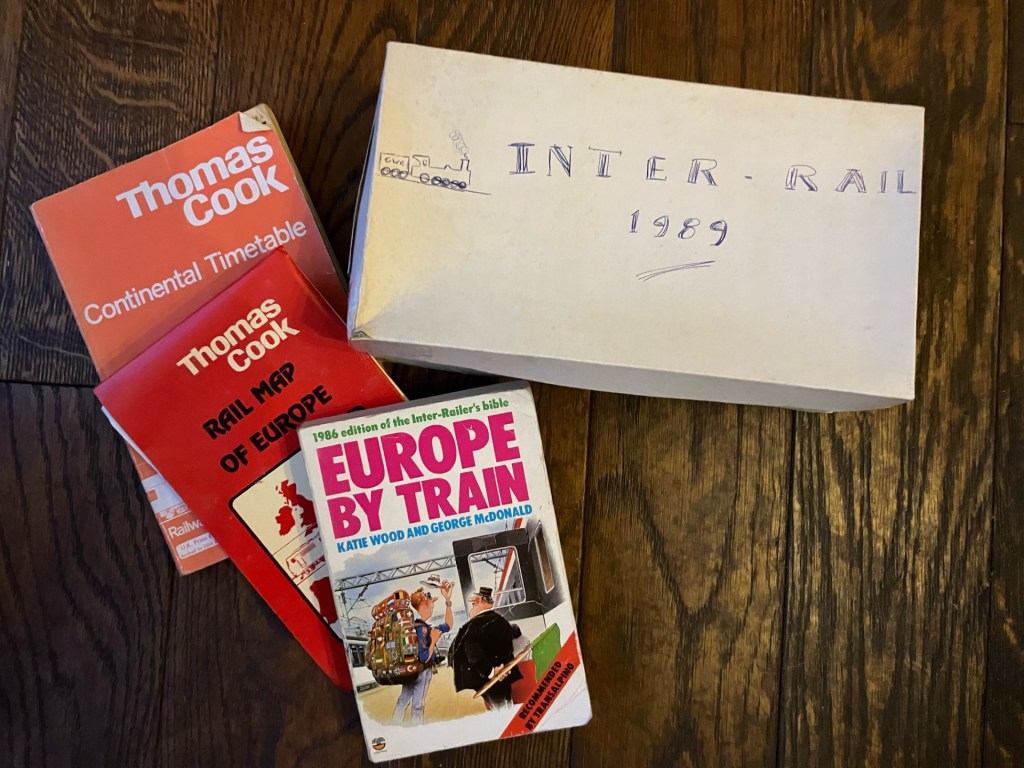
Memory is of course highly fallible and impacted by many factors. Because I was asking participants about their travels which took place between three and six decades ago, I encouraged them to bring along items which could act as memory aids. Many came armed with photos, journals, scrapbooks, guidebooks and well-thumbed Thomas Cook Continental timetables. Meeting face-to face rather than via Zoom or Teams definitely facilitated the sharing of these items.
Learning to listen
The most crucial thing I learnt about conducting oral history interviews is how to really listen. I quickly realised that I couldn’t afford to switch off for a second, or be pondering my next question, because it is too easy to miss something of significance. Also, I became aware that I was only capturing a small fraction of each participant’s history. Yet from time to time, they would veer away from travel and Interrail trips and provide me with insights into other aspects of their lives. These included problems encountered at school, major events which impacted them, and elements of their parents’ histories. Receiving such snapshots was an unexpected privilege as I cut my teeth as an oral historian.
My participants displayed levels of enthusiasm for their Interrail trips and for my research project which I found both encouraging and gratifying. Each participant shared their unique story openly, perceptively and on occasions with raw emotion. They were extremely generous with their time, welcomed me into their homes and workplaces, or travelled at their own expense to meet me at a city centre location. Several times I was given food parcels for my own journey home.
Coming up next
I captured ninety hours of audio-recorded testimony and am now analysing the interview recordings and transcripts as well as beginning the two-year process of writing my thesis. I will be presenting my initial research findings at the Social History Society conference in July 2024 and then in a public talk at the London Metropolitan Archives on Wednesday 18 September 2024. All are welcome to book free places for the September talk, either to attend in person or to join online.
My postgraduate research project was approved by Royal Holloway University of London’s Research Ethics Committee in February 2023 and is supervised by Dr Amy Tooth Murphy and Dr Edward Madigan. Once I have completed the project, the Museum of Youth Culture has agreed in principle to accept the interview recordings and documents into their archive, and also to curate an Interrail exhibition. To find out more about the project or the exhibition, please contact me.
Acknowledgements
Special thanks to all my participants for being so generous with their time, hospitality, and for being willing to go ‘on the record’ and talk about their Interrail experiences. Additional thanks to everyone who suggested potential recruits, to Ellie at Royal Holloway for arranging so many meeting rooms, and to Anne and her team at Penguin Office Services for transcribing the interviews.
 The Long Path